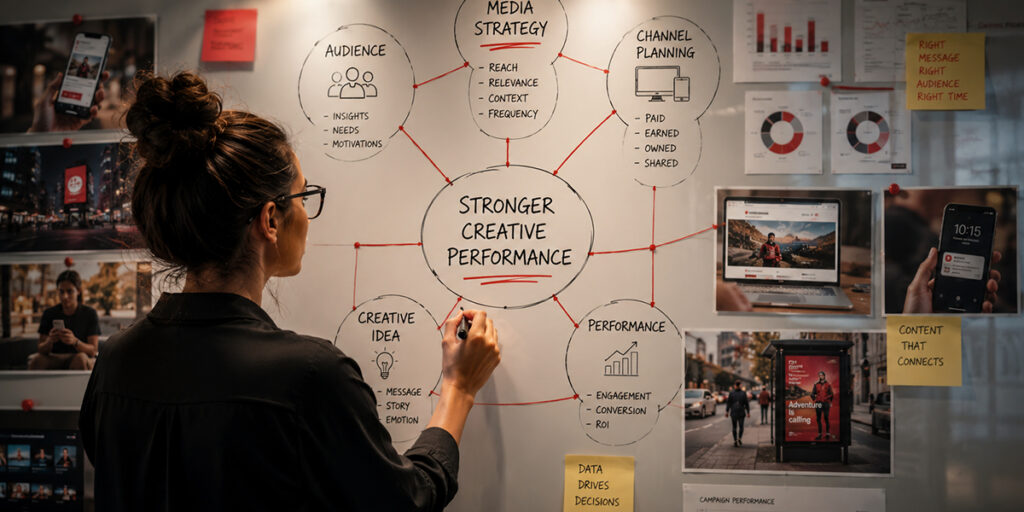
Creative performance depends on more than the strength of the idea. It also depends on where that idea appears, what the audience is doing in that moment, and what the placement needs the message to accomplish.
An advertising agency that understands media strategy can help brands build creative that is more relevant to the channel, the audience, and the action being encouraged. The goal is not to take one campaign idea and resize it across every placement. The goal is to shape the message so it works harder in each environment.
At Pinnacle Advertising, media strategy helps inform creative decisions before assets move into production. Pinnacle uses audience insight, channel planning, format requirements, and performance data to help creative decisions become more focused, more adaptable, and more useful in market.
What is Media-Informed Creative?
Media-informed creative is creative that is shaped by channel strategy, audience behavior, placement format, and campaign goals before assets are built.
This does not mean media dictates the creative idea. It means the creative idea is developed with a clear understanding of how and where the audience will experience it.
A strong campaign idea may need to work across video, social, search, display, retail media, out-of-home, email, landing pages, and local market placements. Each environment creates a different level of attention, intent, and interaction. Media-informed creative accounts for those differences from the start.
That can affect:
- Message hierarchy
- Visual focus
- Offer structure
- Call to action
- Proof points
- Format and length
- Landing page alignment
- Testing priorities
When media strategy shapes creative, brands are better equipped to build assets for how people actually encounter advertising.
Why Creative Cannot Be Separated From Media Context
Creative cannot be separated from media context because the placement influences how the message is understood.
A customer may see a brand message while scrolling quickly through social content, searching for a specific service, watching streaming video, passing an out-of-home placement, browsing a retail platform, or comparing options on a landing page. Each environment creates a different job for the creative.
A social ad may need to stop attention quickly. A search ad and landing page need to answer intent clearly. A video spot may need to create emotional context or explain value. A retail media placement may need to support product consideration near the point of purchase. An out-of-home message may need to communicate one idea in a matter of seconds.
When brands treat these placements as interchangeable, creative performance can suffer. The issue is not always the idea. Often, the idea has not been shaped for the moment in which the audience receives it.
A marketing and ad agency partner should help brands evaluate those moments before creative production begins.
How Media Strategy Improves Creative Performance
Media strategy improves creative performance by giving the message a clearer role in each channel.
When audience behavior, placement context, and media objectives are considered early, creative can be built with more precision. That helps brands avoid generic messaging and create assets that better match the audience’s mindset.
Audience Intent Becomes Clearer
Audience intent changes across media environments.
A person seeing a brand for the first time has different needs than someone comparing options, revisiting a website, searching for a location, or responding to an offer. Creative should reflect those differences.
For example, an automotive shopper may need a simple brand or model introduction early in the process. Later, that same shopper may need inventory availability, feature details, local relevance, financing information, or dealership contact options. If the creative does not adjust as intent increases, the campaign can miss opportunities to move the shopper closer to action.
Media strategy helps define the audience’s likely mindset by channel and placement. That gives creative teams a stronger foundation for deciding what to say, how much to say, and what action to encourage.
Format and Attention Requirements Shape the Message
Every media placement has creative constraints.
Some environments allow more time to tell a story. Others require immediate clarity. Some are visual-first. Others are intent-driven. Some support direct response. Others build recognition over repeated exposure.
Creative performance improves when those realities are treated as strategic inputs, not production details.
A display ad cannot carry the same message load as a landing page. A 6-second video needs a different structure than a 30-second spot. A retail media placement must often make the product and value proposition clear quickly. An out-of-home board should not depend on copy that requires extended attention.
Pinnacle uses media context to help define creative requirements earlier, so teams can build assets that fit the environment instead of forcing the environment to fit the asset.
Message Hierarchy Becomes More Focused
Message hierarchy determines what the audience notices first, what they understand next, and what they are asked to do.
Media strategy helps clarify that hierarchy by identifying the role of each placement. A campaign may have several messages available, but not every placement can carry all of them effectively.
For example:
- Awareness placements may need a clear brand or category message.
- Consideration placements may need proof points, differentiation, or education.
- High-intent placements may need a direct offer, location detail, or conversion path.
- Retargeting placements may need reassurance, urgency, or a reason to return.
The creative idea can remain consistent while the emphasis changes by context. That is the difference between adapting a campaign strategically and simply resizing the same message everywhere.
Creative Testing Has a Clearer Purpose
Creative testing is more useful when the team knows what it is trying to learn.
Without media context, testing can become a collection of disconnected variations. One asset may outperform another, but the reason may be unclear. Was it the audience? The format? The offer? The visual? The placement? The call to action?
Media-informed creative testing starts with a clearer hypothesis.
A team may test whether a product-focused message performs better than a brand message in retail media. It may test whether local relevance improves response in a specific market. It may test whether educational messaging creates stronger engagement for healthcare audiences. It may test whether shorter creative performs better for a high-frequency social placement.
This gives performance data more practical value. Results can inform the next creative decision, not just the next media adjustment.
Where Creative Performance Breaks Down Without Media Context
Creative performance often breaks down when one campaign idea is expected to do the same job in every environment.
The issue is not always poor creative quality. It is often a mismatch between the asset and the context.
Common breakdowns include:
- One message is forced across every channel
- Assets are resized instead of rethought
- Landing pages do not match ad intent
- High-reach placements are expected to drive immediate low-funnel action
- Product or offer details are buried in placements that require fast clarity
- Creative testing lacks a defined variable or learning goal
- Local market needs are added after assets are already built
- Performance data identifies weak response but does not explain what creative decision should change
These problems can make campaigns less efficient. Media may reach the right audience, but the message may not fit the moment. Creative may look strong in isolation, but fail to answer the audience’s immediate need.
A stronger process evaluates creative performance through the lens of audience, placement, format, and intent.
What Brands Should Expect From an Advertising Agency Partner
Brands should expect an advertising agency to help shape creative decisions with media strategy before production begins.
That requires more than having media and creative capabilities available. It requires a process where the agency can translate channel insight into stronger creative choices.
When evaluating an agency partner, brands should look for:
- Media-informed creative briefs
- Audience-intent mapping by channel
- Asset planning by placement and format
- Clear message hierarchy across campaign stages
- Creative recommendations tied to performance data
- Landing page alignment with ad intent
- Testing plans that define what the brand needs to learn
- Strategic guidance on when to adapt, simplify, or expand the message
Pinnacle’s value is in helping brands make those decisions earlier. Instead of treating creative production as the final step after media planning, Pinnacle helps ensure the campaign idea is built for the environments where it needs to perform.
For a broader look at how this collaboration works across agency teams, learn more about how a full-service advertising agency aligns media and creative.
Why Media-Informed Creative Matters for Complex Customer Journeys
Media-informed creative becomes especially important in categories where the customer journey includes multiple decision points, market variables, or trust barriers. Automotive, retail, and healthcare brands often face these conditions, though the challenge looks different in each category.
In automotive, the message may need to shift as shoppers move from awareness to model research, inventory comparison, local search, and dealership engagement. Creative that works for early awareness may not answer the practical questions that matter closer to purchase.
In retail, creative often needs to account for promotional timing, product visibility, digital engagement, store traffic, and loyalty behavior. A message that builds general brand interest may need to become more specific when the audience is closer to a product or store-level decision.
In healthcare, the audience may need education, reassurance, local relevance, and a clear next step. Creative must often balance clarity and trust while making it easy for the audience to understand what action to take.
For multi-location brands, these needs become more complex. Campaigns must preserve brand consistency while adapting creative to local market conditions, audience behavior, and service or product priorities.
Media-informed creative helps brands manage that complexity with more precision. It keeps the core idea consistent while allowing the message to do the right job in the right context.
Stronger Creative Starts With Smarter Media Context
Creative does not perform in a vacuum. It performs inside a media environment.
The more clearly a brand understands that environment, the more effective its creative decisions can become. Audience intent, placement format, timing, channel role, and performance data should all inform how the message is shaped.
For marketing leaders, the goal is not to create more versions of the same asset. The goal is to create more useful creative. Useful creative reflects the audience’s mindset, fits the placement, supports the campaign objective, and gives the brand a clearer path to improvement.
This is where media-informed agency planning becomes valuable. An advertising agency that connects media strategy to creative development can help brands make smarter decisions before campaigns launch and more precise improvements once performance data comes in.
To see how Pinnacle brings media-informed creative thinking to real client challenges, explore our recent campaign work. This is also where creative strategy comes to life across channels, because the same idea may need to work differently depending on audience intent and placement context. To discuss how smarter media context could strengthen your next campaign, get in touch with us.
FAQs About Media Strategy and Creative Performance
How does media strategy improve creative performance?
Media strategy improves creative performance by helping brands understand audience intent, placement context, format requirements, and channel objectives before assets are built. This makes the creative more relevant to how and where the audience receives the message.
What is media-informed creative?
Media-informed creative is creative that is shaped by channel strategy, audience behavior, placement format, and campaign goals. It helps ensure the message is designed for the environment where it will appear.
Why should creative be adapted by channel?
Creative should be adapted by channel because each media environment creates different levels of attention, intent, and interaction. A message that works in one placement may need a different structure, hierarchy, or call to action in another.
What happens when creative is not built for media context?
When creative is not built for media context, campaigns may rely on generic assets, mismatched messaging, weak landing page alignment, or creative testing that does not produce useful learning. This can reduce relevance and limit campaign performance.
What should brands look for in an advertising agency?
Brands should look for an advertising agency that uses media strategy to inform creative briefs, asset planning, message hierarchy, landing page alignment, and testing recommendations before campaigns launch.